
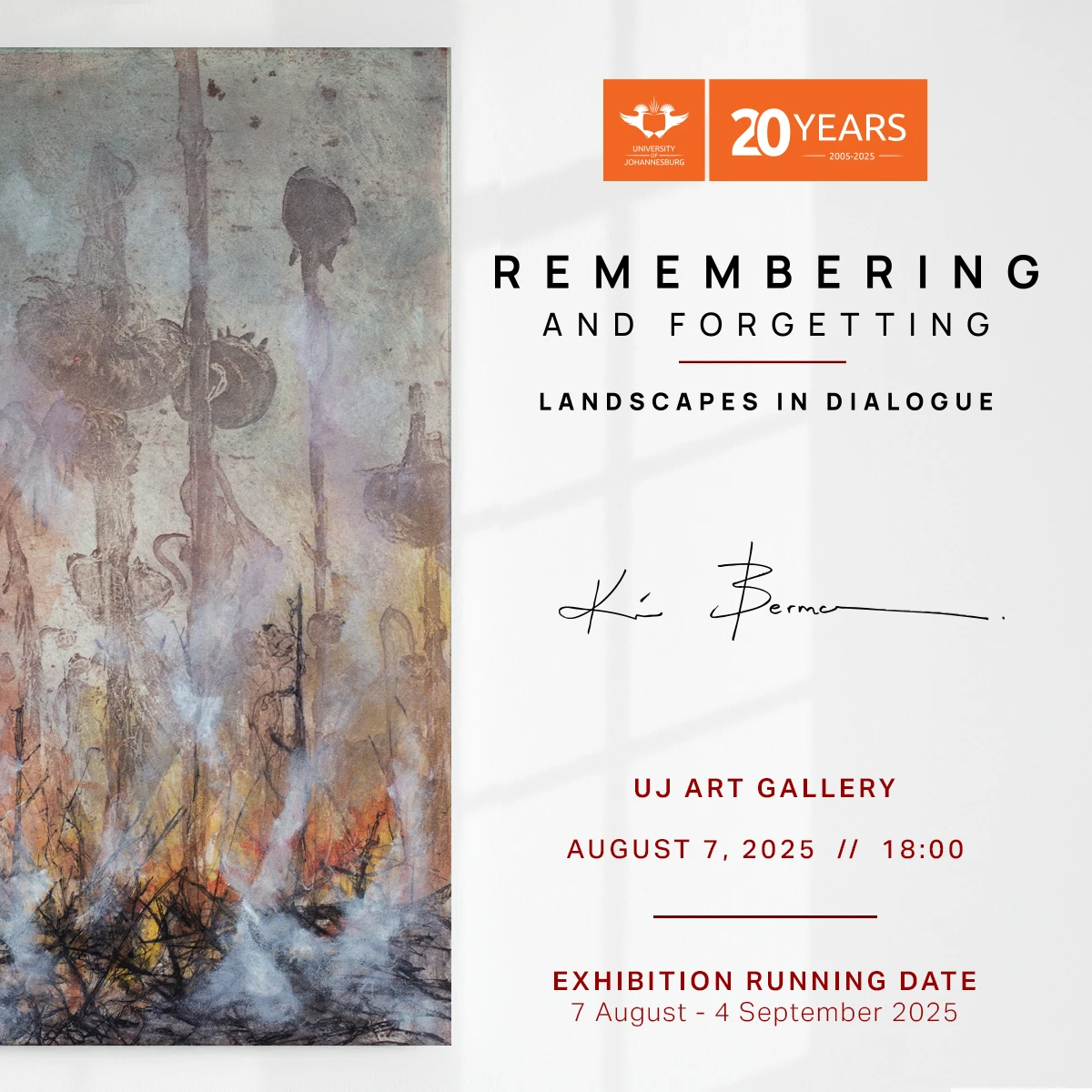
Exhibition Statement
Kim Berman’s Remembering and Forgetting: Landscapes in Dialogue
The landscape in her work has always served as a metaphor for social, environmental, and political events, expressed through the interplay of darkness and light on the horizon.
This exhibition, Remembering and Forgetting, excavates her past works—some dating back to her student days in the 1980s that have never before been shown in South Africa, and others created more recently. In selecting these works, she was struck by the ways in which certain themes recur—always somewhat transformed, yet appearing as a dialogue between different landscapes. These dialogues echo familiar concerns in new forms, offering fresh perspectives on enduring issues, while also revealing new questions rooted in historical memory.
One of the core ideas explored in this exhibition is that of “rusted ghosts.” The artist has reclaimed old rusted etched plates, cutting and reusing them to forge a link between past and present. Some images bear foreboding traces of war and destruction over faded, burnt landscapes, evoking the horror of a world at war that permeates daily consciousness. Yet within these images, a glimmer of light always remains—a sign of life. Another recurring motif is the field of mourning sunflowers, symbolizing collective grief while simultaneously embodying regeneration through the continual dropping of seeds. Fire and smoke are pervasive in her work: smoke both evokes and conceals fire, masking and revealing, choking and beautifying. Fire itself burns and destroys, yet also renews the earth.
The exhibition is grouped into broad and overlapping themes:
- State of Urgency
- Sunflowers in Mourning
- Fire and Smoke
- Mining and Damaged Landscapes
- Artists’ Books
- Fire Revisited
A recent home fire that destroyed her office and its contents became an extraordinary event—both in its timing and its symbolic connection to this exhibition. While the damage was significant, it remained limited, standing in contrast to the devastating fire at Artist Proof Studio in 2003. The experience reawakened deep memories and emotions, reaffirming her creative connection to the metaphor of fire as both a force of destruction and renewal.
Her work seeks to hold the paradoxes of the land—scarred by deliberate harm yet still holding within it the promise of empathetic humanity.
This exhibition coincides with the 20th anniversary celebrations of the University of Johannesburg and marks the culmination of her 31-year tenure. Though she has continued to create work sporadically, this is her first solo exhibition in 15 years. During that time, her focus has been dedicated to her roles as educator, researcher, and activist. Now, as she returns to artmaking in her retirement year at 65, the process has become one of reflection, renewal, and reinvention—a celebration of a lifelong dialogue between art, memory, and transformation.